

Open March to December: Friday & Saturday 11am - 2pm - Adults £3; Concessions £2.50; Under 16 £1.50

A Journey of Discovery...
Dereham Windmill is a striking Grade II listed tower mill and one of the town’s most distinctive historic landmarks.
Built in 1835–1836, it stands five storeys high and was once one of several mills serving the local area—today, it is the last remaining example in Dereham.
The mill was equipped with two pairs of patent sails mounted on an iron windshaft, which powered two pairs of millstones, a flour mill, and a jumper. A third pair of stones was later added on the stone floor.
To maintain operation when wind power was insufficient, auxiliary power was introduced.
The Windmill is open to the public a certain times during the week, ready for you to discover a part of our heritage.

A Story of Dereham Windmill
In 19th-century Dereham, like other towns and cities, wind and water powered mills were essential to their local community. Millers would have sourced grain from surrounding farms, ground it into flour, and supplied both households and nearby bakers.
In 1836 a tower mill was built on the outskirts of Dereham by local miller and baker Michael Hardy. Together with millwright James Hardy they constructed a mill rising to 42 feet and measuring 24 feet in diameter at its base.
A steam engine was fitted to provide backup power when the wind was calm. This drove the machinery via a shaft entering through the east window on the second floor, connecting to a wooden crown wheel on the upright shaft.
By 1837 Hardy had advertised the mill to let and another miller, John Armes, took over its operation. Despite his experience, Hardy ran into financial trouble and in 1844 Dereham Windmill was sold at auction.
The mill was bought by William Fendick for £650. It continued operating as a corn mill, grinding grain into flour for the local area for decades, staying in the Fendick family until 1909. The windmill was subsequently purchased by Charles Robert Gray and Arthur James Milk.
During the first world war Dereham Windmill was used for grist milling, oats, barley etc. for animal feed including acorns for pigs. Wheat was no longer milled for flour.
The mill was kept operational under wind/steam power until Gray's death in 1922. It was decided to remove the sails and replace steam power with a parrifin engine. When Milk died in 1926 the firm was carried on by William Robert Gray, Arthur Payne Milk and Henry Jonas Harding Garlick trading as Robert Gray Ltd.
Dereham Windmill continued to operate in this fashion until 1937 when milling ceased and by 1949 the mill was derilict.
In 1972 it was given Grade 2 listing status and five years later the remains of cap frame and windshaft removed. The following year, 1978, the mill was bought by Breckland District Council from for £1 and plans were put in place to restore the windmill.
In 1986 a new cap and fantail were fitted followed by new sails in 1987. It was in that year that Dereham Windmill was opened to the public.
The mill was taken over by Dereham Town Council in 2002.
In January 2004 a storm caused the mill to lose a part of a sail. The sails were subsequently removed for renovation and a £60,000 Lottery Grant
was applied for.
In February 2010 the mill was boarded up and left weatherproof as all attempts at funding had failed. The following year however sufficient funds had been oragnised for the windmill undergo further renovation, including installation of replacement sails.
Finally in 2013 the windmill re-opened to the public as a “Community Exhibition Centre”.
Raising funds for the continued upkeep of the windmill continues to this day. The Dereham Windmill Trust hold regular events in the grounds and it invited members of the public to become "Friends of Dereham Windmill".
If you are able to help, please visit our Support page where you will find the different ways you can keep this hostorical building alive.


Michael Hardy Junior c 1880

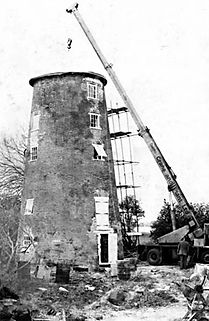
Dereham Towermill Restoration 1982
What the Mill Made
Dereham Windmill was primarily used for milling grain into flour.
Powered by wind (and later by engines when there was no wind), the mill’s sails drove large millstones inside the tower.
Local farmers brought their harvested crops—mainly wheat—to be ground into flour for baking bread, as well as other products like meal and animal feed.
In essence, it served as an important part of the local food supply chain, turning raw grain into usable food products for the Dereham community and surrounding countryside.

How it Worked
Dereham Windmill worked by using the power of the wind to drive machinery inside the tower and grind grain into flour.
Here’s how it operated:
1. Capturing the wind
Large sails at the top of the mill caught the wind. The cap of the tower could be turned so the sails always faced into the wind, helped by a small rotating fan at the back (called a fantail).
2. Turning the machinery
When the wind pushed the sails, they rotated a horizontal shaft (the windshaft). This motion was transferred through a series of wooden gears inside the mill.
3. Driving the millstones
The gears turned vertical shafts connected to millstones. Grain was fed between two large circular stones—one fixed, one rotating—which ground it into flour.
4. Producing flour
The ground flour was collected on lower floors, where it could be bagged and prepared for use or sale.
5. Working without wind
When there wasn’t enough wind, Dereham Windmill could switch to auxiliary power. It first used a steam engine, and later a paraffin engine, to keep the machinery running.
In simple terms, the windmill converted wind energy into mechanical power, allowing it to turn grain into flour efficiently for the local community.
